In hooves there are three void spaces that tell us as much about the feet and their state of health as the physical structures do.
The central sulcus is the space between the two legs of the frog. An optimal central sulcus is situated at the caudal half of the frog and opens out of the end of the foot in the shape of a triangular wedge.
The collateral grooves are the spaces between each side of the frog and the bar lateral to it. In an optimal foot both the sides of the frog and the bar will be straight, and the caudal end of the collateral groove will be occluded by the frog curtain.
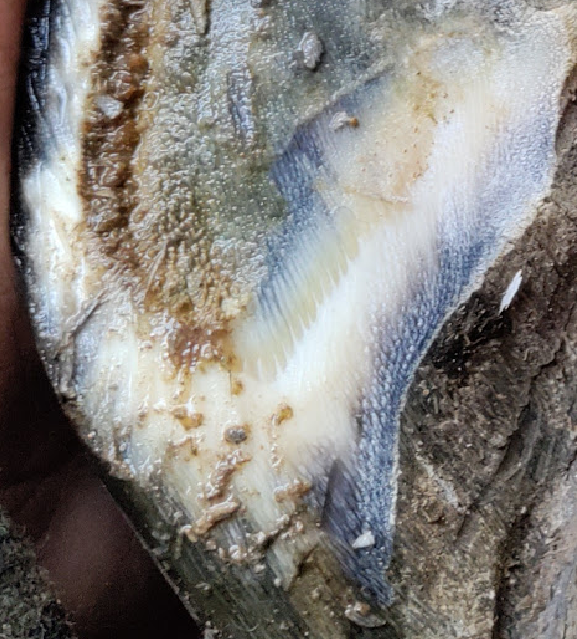
These are the thin fingers that inter-digitate between the internal hoof and outer capsule. The internal hoof is sensitive, having nerve cells. The outer capsule, while still ‘live’, while aligned with and being fed by the inner hoof, is insensitive, not having nerve cells.
What even are they and where are they each borne from?
“What are they?” is a very technical question. I want also to know the molecular makeup of each.
“Where are they borne from?” is equally technical. Do they all exude from the coriums, tubules…? I’m guessing that the laminar serum exudes from the laminae, most likely the terminal laminae that grow from the lowest point of each sensitive lamina, creating the ‘white’ line.
Cheryl Henderson, creator of the ABC trim examines sole material by taking a very thin sliver and folding it. She maintains that if the sliver after having been folded, springs back open, then it is bar material. If the sliver after having been folded, retains a crease, it is sole material. A trimmer friend had mentioned Cheryl’s “beetle experiments” to me during a conversation on soles. So I went to the ABC page on Facebook and searched for them. Her photos show hoof capsules that were left in containers of flesh eating beetles that she uses to clean bones. The beetles, she maintaine, would eat sole but not wall. Some of the capsules had slabs of uneaten material over varying parts of the sole plane. While I found the studies interesting, and can see how one might come to the conclusion that what was left on the sole was migrated bar, I’m still not convinced.
Yesterday I took some slivers from the hard grey sole on my geldings feet. When I folded them they sprang back open in just the way, as it’s said by Cheryl, that run forward bar does. When I look at them under the microscope top lit, they appear gray. When I look at them bottom lit, they are not gray but ruddy/brown/amber with brighter flecks of blood in spots. The tubules in these sections also seem to be very shallow in angle.
It’s my theory that healthy sole grows at the same angle as healthy capsule, and when it is at this angle. And when sole grows at an optimal angle, there is an inter-tubular wax exuded from some part of the sole corium/papilae. And when the sole tubules are forced into a more shallow angle of growth, they cannot function the same. And due to being much less stiff than wall tubules, they lay over due to compressive forces and at this sub optimal angle the corium/papillae can no longer exude the waxy substrate. It’s at this point, in the absence of that substrate that something else get exuded in it’s place, or maybe not, maybe this hard, (at least sometimes) grey sole is just what happens in the absence of waxy substrate. It may be blood or blood filled lymph, or that orange serum that sometimes presents on some soles when unhealthy.
I’m trying to find a lab that will do some histology on samples in order to further my understanding. The white sole sliver I took off my horse when folded, holds it’s crease. The grey sole when folded springs open. But I’m not ready to believe that it is bar material that is run forward. On these same feet, when I trim bar to sole level I can see very clearly the white line and the evidence in the laminar serum of the bond of laminar serum and insensitive laminae. And there is no evidence in this white line of bar tubules crossing over it.
But bear in mind, this is just the first flush of my looking at all this. I wouldn’t be surprise if there’s not more to see that’s I’ve not seen yet.
The idea that the hoof holds onto or grows anything because it has a mindful preference for that thing has always baffled me. If we really believe that, why trim at all? If we believe that, every horse has exaclty the foot it wants, even the corkscrewed ones.
This false sole is there for a reason, for sure. But it’s not because the hoof or horse wants it there. It is there because this hoof has been trimmed in a way that created a situation where dead sole could not naturally slough off.
Hooves are devices that run on proprioceptive input and responses to ground forces. They are machines, of sorts, running on a program, and responding to their environments. They are programmed to grow and respond, at a biological level. They are not at all thinking structures with opinions. They run on input of information and output of growth. And their ability to run according to their programming can be hampered by how they are maintained by ground forces or humans. The more parallel the walls of a foot, the easier it is for dead sole to remain trapped and tamped solid by ground forces, especially as the wall grows beyond live sole, especially if the wall is heavy and strong or held tight by a shoe.
When heel buttresses are laid forward, bars are going to lay down on the sole.
It is possible for a hoof capsule to be so compromised that the wall corium from which the buttress grows no longer produces a full buttress.* The back end of the hoof is made of soft tissues. These soft tissues can and will compress when the capsule is trimmed incorrectly. When this happens, the bar is no longer truly attached to the buttress. I’ve seen more than a few hooves where the bar is butted up against wall, as opposed to there being a robust buttress connecting wall and bar. A true and robust buttress provides support the bar attached to it. One job of a buttress is to support the bar structures in maintaining their optimal angle. Optimal bars grow straight from and with a strong attachment to the buttress. From the buttress they grow straight to their natural termination approximately half way down the frog.
When the bar does not have a true attachment to the buttress, it has nothing to hold it vertical. An unattached bar is totally and completely subject to ground forces. The relative integrity of the hoof in front of/under unattached bars may keep them in place to an extent and for a time. This, though, is dependent on how the rest of the hoof capsule is being maintained.
*Similar to what happens to grass if you lay something it, the grass will not grow.
Another thing that just came to me regarding bars…
I’ve seen many hooves that have the tell tale cracks at the natural terminus of the bar. I’ve seen some too, that don’t have it. It occurred to me yesterday that that cracking very likely corresponds to the flex point in the foot that is determined by the caudal end of the coffin bone. The inner sensitive hoof has the coffin bone for structure in the front half (and half is used loosely here), and the back/caudal half of the foot is made up of tough yet flexible structures. So when a horse lands on it’s heels, and then transfers it’s weight forward during locomotion, there’s a bend point that happens between the front and back parts of the foot.
When the hoof is of optimal size, and the corium that grows the bars is as long as is intended by DNA, the flex point falls at the natural terminus of the bars and cracking is visible. When a hoof is foreshortened and the corium that grows the bars is pushed forward into the capsule and under the coffin bone, the natural terminus of the bars is pushed forward as well. When the natural terminus of bar is forward of this flex point that leaves solid bar over the flex point, and solid bar is much less likely to crack due to it’s very design.
the ability to sense the position and location and orientation and movement of the body and its parts
There’s so much to say.
The hoof is structure that works on feedback between it’s receptors and ground forces.
Hooves that run forward and grow toe and long under-run bars quickly, are doing so because the proprioceptive receptors are not getting pressed in such a way that growth is signaled that it can slow.